Kane Kosugi’s Japanese, the first female leader, the demands of the US Power Rangers. We list only what the sources confirm.
Cast
They rewrote the role to fit his halting Japanese.
Kane Kosugi (Ninja Black / Jiraiya) had only just moved to Japan the year before and was shaky in Japanese. Producer Takeyuki Suzuki suggested a language school, then decided his halting delivery was itself appealing — casting him as-is and rewriting the role into "a ninja raised in America." A case of reshaping the character to fit the actor.
Confirmed Production
US Power Rangers’ needs reshaped the show’s back half.
Producer Jun Kaji has said he built the show as a "Journey to the West-style" road story while also deliberately cutting back on unmasked regular appearances in the back half — to secure footage (helmet-on action with no faces) for the US Power Rangers Season 3. A clear case of Japanese Sentai production being shaped by overseas plans.
Confirmed Setting
The series’ first “second five-machine combiner.”
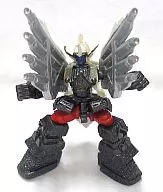
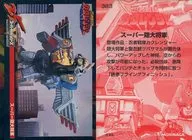
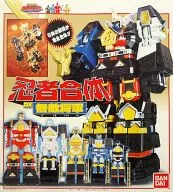
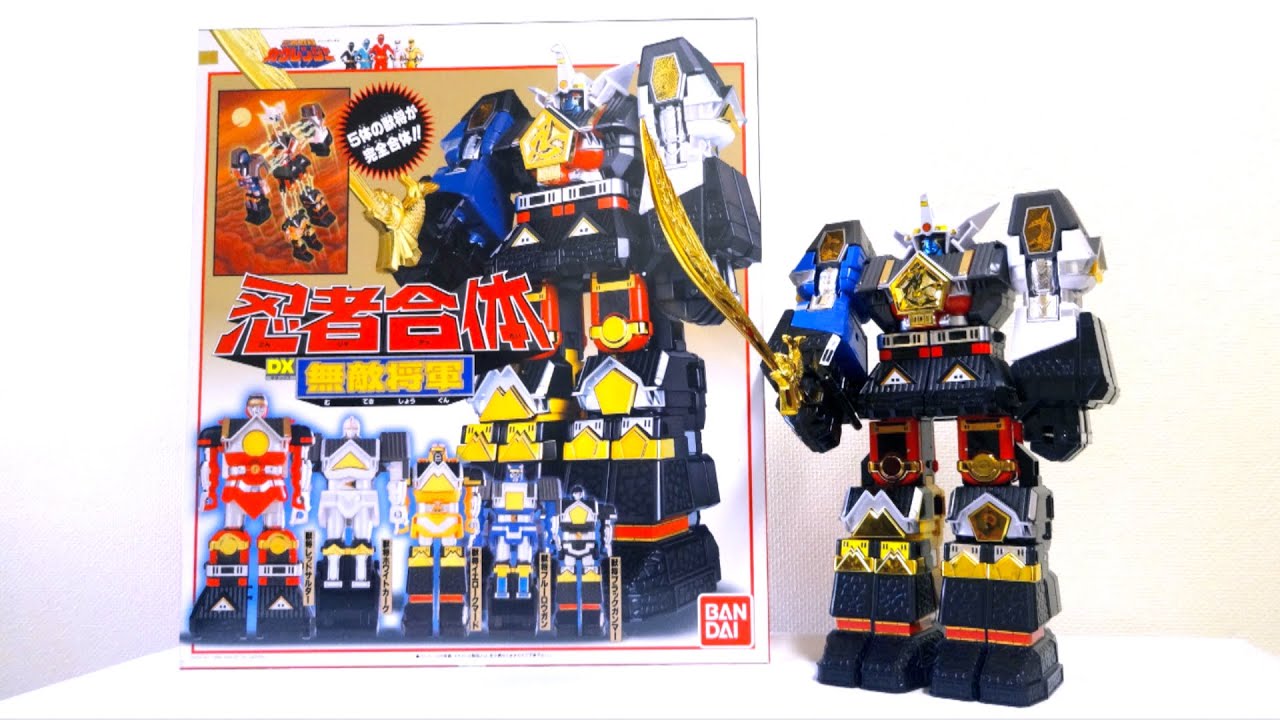
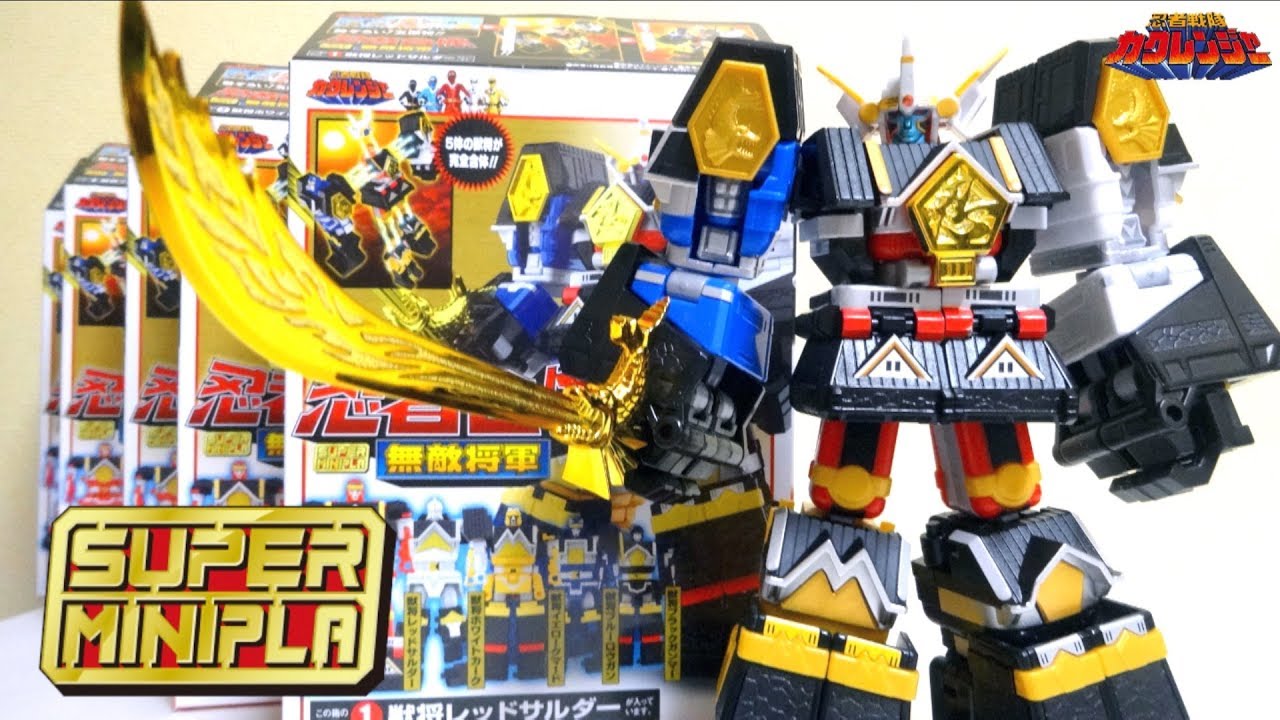
The giant robo Kakure Daishogun was the series’ first "second five-machine combiner," with White (Tsuruhime)’s mecha forming the head — a departure from the usual layout. It has multiple combined forms, including Muteki Shogun and Super Muteki Shogun.
Confirmed Reception
Why the narrator was written out is still disputed.
Rakugo storyteller Enjō Sanyūtei, who played the on-screen "Kōshakushi" narrator, has recounted being written out at Bandai’s request over toy-sales concerns. Producer Seiji Takatera, however, denies any such request — so the real story is genuinely contested.
Likely Reception
Thirty years on, the show is still being kept alive.
For its 30th anniversary in 2024, Kane Kosugi’s "Ninja Exercise" was released on the Toei Tokusatsu Fan Club — one sign the show is still actively kept alive, following its original child viewers into adulthood.
Confirmed Setting
The five are named after the Sanada Ten Braves.
The five are named after legendary ninja of folklore — the Sanada Ten Braves. Sasuke descends from Sarutobi Sasuke, Saizō from Kirigakure Saizō, Seikai from Miyoshi Seikai, and Jiraiya from the tale of Jiraiya. And White / Tsuruhime is the first time in Super Sentai that a female warrior — and a non-Red one — was made the team leader, breaking the usual lineup.
Confirmed Production
One writer and composer ran across all three shows.
Head writer Noboru Sugimura continued from Zyuranger and Dairanger, and Eiji Kawamura returned as composer from Dairanger. These three shows shared the same core of script and music — meaning the 1992–94 "seam trilogy" whose footage crossed over into the US Power Rangers was, on the Japanese side, held together by a continuous creative team.
Confirmed Setting
A mythic good-vs-evil frame sits behind the robots.
The Sanshinshō (Three Generals) are said to have risen from the souls of three sages who fought the yokai two thousand years ago. Cast as embodiments of love, courage and hope, they stand opposite the Yokai Daimaō — embodiment of anger, grief and despair. A mythic frame, pairing good and evil as contrasting emotions, sits behind the giant robots.
Confirmed Setting
The enemy unit turns out to be five cats.
The enemy unit "Hana no Kunoichi-gumi" turn out to be five cats kept by Junior. In the final battle they are caught in a beam from Kakure Daishōgun, revert to ordinary cats, and vanish. A comic enemy troupe was given this late reveal.
Confirmed Production
The concept: “Japanese, but not Japanese.”
Toei producer Takeyuki Suzuki pitched the show on the idea of "Japanese, but not Japanese," aiming for a ninja-hero image the franchise hadn’t done before — and bringing a full Japanese flavor into the series.
Confirmed Production
The enemy yokai concept: “yokai from the Bronx.”
The enemy yokai were designed around director Yoshiaki Kobayashi’s notion of "yokai from the Bronx" — pulled away from received images of yokai toward a casual look closer to street fashion.
Confirmed Production
Japanese yokai began from Sesame Street.
Tamotsu Shinohara, who designed the yokai, has said he began drawing from the image of the characters in Sesame Street — Japanese yokai started, in other words, from Western puppets.
Confirmed Production
Not slated for a toy — then it became a hit.
Ninjaman, the giant robot, was not originally slated for a toy; after it proved popular on air it was productized and became a major hit — a case of audience response moving the merchandise line after the fact.
Confirmed Scrapped
The popular “sixth warrior” was dropped this time.
There was a push to carry over the "sixth warrior" that the previous two shows had made popular, but it was ultimately dropped and the series returned to a conventional five-member team.
Confirmed Scrapped
The kunoichi were first planned as an enemy team.
In planning, the "Hana no Kunoichi-gumi" were conceived as an enemy *team* replacing the regular villain organization. Per producer Jun Kaji, an early idea had a three-way scramble between the Kakurangers, the villains and the kunoichi.
Confirmed Scrapped
One name was changed to avoid clashing with another show.
One member of the kunoichi unit was originally named "Sumire," but the name was changed because a character of the same name appeared in Blue SWAT, broadcast the same year.
Confirmed Cast
He prepared as Son Goku — the scripts said otherwise.
For Red/Sasuke, Teruaki Ogawa found the planning document framed the role as a Son Goku type; he prepared by watching monkeys at the zoo and picturing Masaaki Sakai’s Saiyūki, only to be thrown when the actual scripts gave him a different character.
Confirmed Cast
Real father and son shared the screen.
In episodes 28 and 29, actor Shō Kosugi — the real father of Kane Kosugi, who played Jiraiya — appeared as a guest, putting father and son on screen together.
Confirmed Cast
A veteran robot suit actor finally played a hero.
Hideaki Kusaka, long a suit actor for the giant robots, played a hero-side character for the first time in this show — as the giant hero Ninjaman.
Confirmed Reception
A woman — and a non-Red — led the team for the first time.
Tsuruhime is the first case in Super Sentai of a leader who is both a female member and a non-Red warrior — a small break from the standard way teams are arranged.
Confirmed Analysis
The producers’ constraints became the show’s very appeal.
In our reading, Kakuranger is a rare case where the producers’ constraints and the show’s appeal pointed the same way. The role of Ninja Black was rewritten into "a ninja raised in America" to fit Kane Kosugi’s halting Japanese, and unmasked appearances were cut back in the second half to secure faceless action footage for US Power Rangers Season 3. Constraints that could have hamstrung a show instead meshed with its five heroes named after the Sanada Ten Braves, its Journey-to-the-West road structure, and its placing of a non-Red woman, Tsuruhime, as leader for the first time — turning into the show’s identity. Behind this sits a continuous core: writer Noboru Sugimura and composer Eiji Kawamura ran across the whole Zyu/Dai/Kaku run. The "seam trilogy" that took the hardest hit from export demands was, we argue, able to translate those demands into strengths precisely because the same hands held it together.
Likely Editorial notes
The series' first female team leader
Ninja White / Tsuruhime, heir to the Kakure ryū, leads the team — the first female team leader in the series.
The first additional warrior with no human form
Ninjaman / Samuraiman, disciple of the Three Godgenerals, was the first additional warrior with no human form.
A two-part structure: comedy first, drama later
The show was built in two parts — episodes through 24 as Part One, episode 25 onward as Part Two, "Seishun Gekitō-hen" (Youth Battle Arc). Part One ran on comedy, with the female leader Tsuruhime alongside a duty-shy male team; as the story advanced its battle-action side grew, and from Part Two the tone turned more serious, in step with the rangers' growth.
The "Kōshakushi", an on-screen storyteller
Each episode features a narrator called the Kōshakushi (a classical raconteur). Appearing with a ninja-like puff of smoke, he recaps the plot, explains the yōkai and previews what comes next, signing off each time with "See you next week — Kakuranger!" It turns the usual off-screen narration into an on-screen guide who brings the audience closer to the show's world.
Three giants for mind, technique and body
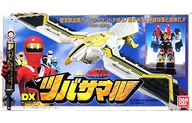
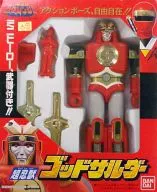
The giant robots comprise three figures — Muteki Shogun, Tsubasamaru and Kakure Daishogun — set up as the "Three Godgenerals" governing mind, technique and body. Rather than collapsing into a single combining robot, this trio of deities forms the backbone of the show's giant-scale battles.
A changing writers' room: Soda returns, Fujii departs
Hirohisa Soda, a former head writer, joined partway through and wrote twelve episodes. Meanwhile Kunio Fujii — a sub-writer on Sentai since Bioman (Zyuranger aside) — left the Super Sentai series for good after writing this show's episode 32.
Watanabe directs a career-high 14 episodes; Butsuda debuts on the main unit
On direction, Katsuya Watanabe — still in his twenties at the time — handled a career-high 14 episodes here. Hiroshi Butsuda, until then known for his special-effects (tokusatsu) direction, also made his debut directing the main unit on this show.
A generational handover in character design
Character design carried over Yasushi Shinohara and Michael Harachoh from the previous year, joined by newcomers Hideo Okamoto and Osamu Abe. Abe would go on to design Sentai characters from this show through Mirai Sentai Timeranger, while Shinohara — in effect swapped out — left the series after this entry.
18th Super Sentai entry, and the first ninja motif
The show is the 18th entry in Toei's Super Sentai series, and the first in the franchise to base its heroes on the ninja motif.
Time slot and the 53-episode run
It aired on the TV Asahi network's Friday 17:30 slot from February 18, 1994 to February 24, 1995, for a total of 53 episodes.
Who "Two-Chi-Chen", the theme singer, really was
"Two-Chi-Chen", who sang the opening "Secret Kakuranger" and the ending "Ninja!! Matenro Kids", was a pen name of the songs' own composer Takashi Tsushimi — his surname "Tsushimi" read in Chinese.
Kane Kosugi as Ninja Black — and a father-son appearance
Ninja Black / Jiraiya was played by Kane Kosugi, eldest son of Hollywood actor Sho Kosugi; Sho himself guest-starred in episodes 28–29, making it a father-and-son appearance.
The Yokai Army, born of humanity's dark heart
The enemy Yokai Army is framed as born from the negative emotions — anger and hatred — lurking in human hearts, and its leader, the Great Yokai Demon King, is defined so that the very source of its power is human hatred itself.
Suits carried over to the U.S. (Alien Rangers)
The show's action footage was reused in season three of Mighty Morphin Power Rangers and in Mighty Morphin Alien Rangers — and in the latter the Kakuranger suits themselves were used directly.
FAQ
Did Power Rangers use footage from Ninja Sentai Kakuranger?
Yes. The US series MMPR S3 / Alien Rangers (1995) was built by reusing this show’s suited-action and giant-robot footage, with only the drama scenes shot anew in America. Reused mainly: Muteki Shogun → Shogun Megazord, Ninjaman → Ninjor, Kakuranger suits → the Alien (Aquitian) Rangers.
How many episodes is Ninja Sentai Kakuranger, and when did it air?
53 episodes. It aired from February 18, 1994 to February 24, 1995.
Who is the “sixth warrior” of Ninja Sentai Kakuranger?
Ninjaman. The blue giant Ninjaman is the "sixth". The leader is the 15-year-old Tsuruhime / Ninja White.
Can I still buy vintage Ninja Sentai Kakuranger toys?
Yes. Figures and DX toys still circulate on Japan’s second-hand market (Suruga-ya, Mercari, Yahoo! Auctions). Real listings are linked throughout this page; overseas buyers can follow our buying guide.





![忍者戦隊カクレンジャー 第三部・中年奮闘編【Blu-ray】 [ 八手三郎 ]](https://thumbnail.image.rakuten.co.jp/@0_mall/book/cabinet/9901/4988101229901_1_2.jpg?_ex=600x600)
![【送料無料】忍者戦隊カクレンジャー 第三部・中年奮闘編/小川輝晃[Blu-ray]【返品種別A】](https://thumbnail.image.rakuten.co.jp/@0_mall/joshin-cddvd/cabinet/801/bstd-21004.jpg?_ex=600x600)

![忍者戦隊カクレンジャー 第三部・中年奮闘編 (本編32分/)[BSTD-21004]【発売日】2025/3/12【Blu-rayDisc】](https://thumbnail.image.rakuten.co.jp/@0_mall/cyberbay/cabinet/250116/p1_h2114279w.jpg?_ex=400x400)
![【中古】(未使用・未開封品)忍者戦隊カクレンジャー 第三部・中年奮闘編 [Blu-ray]](https://thumbnail.image.rakuten.co.jp/@0_mall/kobaco-003/cabinet/20251013-1/b0dqxjts3d.jpg?_ex=400x400)

![忍者戦隊カクレンジャー DVD COLLECTION VOL.1 [ 八手三郎 ]](https://thumbnail.image.rakuten.co.jp/@0_mall/book/cabinet/6627/4988101226627_1_2.jpg?_ex=600x600)
![【中古】内袋未開封)BANDAI スーパーミニプラ 忍者合体 無敵将軍 忍者戦隊カクレンジャー[19]](https://thumbnail.image.rakuten.co.jp/@0_mall/otakarasouko/cabinet/_1136/1240019530847_1.jpg?_ex=600x600)
![【中古】[PTM] (食玩) プレミアムバンダイ限定 スーパーミニプラ 五神合体 隠大将軍&ツバサマルセット 忍者戦隊カクレンジャー プラモデル バンダイ(20180901)](https://thumbnail.image.rakuten.co.jp/@0_mall/mediaworldkaitoriworld/cabinet/6316/0/cg63160109.jpg?_ex=600x600)

![【中古】[PTM] (食玩) スーパーミニプラ 忍者合体 無敵将軍(5個入) 忍者戦隊カクレンジャー プラモデル バンダイ(20180924)](https://thumbnail.image.rakuten.co.jp/@0_mall/mediaworldkaitoriworld/cabinet/6316/0/cg63160987.jpg?_ex=600x600)


![NO.18[SEC]:忍者戦隊カクレンジャー](https://cdn.suruga-ya.jp/pics_webp/boxart_m/gu417468m.jpg.webp)
![4[プリズム]:スーパー無敵将軍](https://cdn.suruga-ya.jp/pics_webp/boxart_m/gl430956m.jpg.webp)
![RS-550[R]:隠大将軍](https://cdn.suruga-ya.jp/pics_webp/boxart_m/g8932250m.jpg.webp)

![忍者戦隊カクレンジャー 第三部・中年奮闘編 [初回版]](https://cdn.suruga-ya.jp/pics_webp/boxart_m/429001985m.jpg.webp)




![忍者戦隊カクレンジャー超全集【電子書籍】[ てれびくん編集部 ]](https://thumbnail.image.rakuten.co.jp/@0_mall/rakutenkobo-ebooks/cabinet/2133/2000002272133.jpg?_ex=600x600)
![スーパー戦隊 (学研の図鑑) [ 東映株式会社 ]](https://thumbnail.image.rakuten.co.jp/@0_mall/book/cabinet/7882/9784054067882.jpg?_ex=600x600)

