The premise that “Chōriki” is science rather than psychic power, the twentieth-anniversary banner, and how it crossed the ocean to become Power Rangers Zeo. We list only what the sources confirm.
Setting
The power source is science, not superpowers
Their power derives from THenergy left by a super-ancient civilization, amplifying physical ability 30–40×. Producer Suzuki framed it as the pinnacle of science, explicitly distinct from occult superpowers.
Confirmed Setting
A team made entirely of soldiers
All members belong to U.A.O.H., a U.N.-affiliated body, as professional soldiers. Unlike civilians who stumble into power, this military origin underpinned the early hard tone.
Confirmed Production
Social events reshaped the tone
After the Hanshin quake and the sarin attack that year, producer Suzuki wrote of facing a real evil that surpassed fiction’s villains. The original hard line was abandoned and comical elements added.
Confirmed Production
The pivot episode is disputed
The shift toward comedy is well documented, but the “which episode” varies by source — some secondary write-ups cite around episode 20, with no firm primary citation. This is our reading: the change likely unfolded gradually over several episodes rather than in one.
Likely Cast
A sixth ranger in the form of a boy
King Ranger’s true form, Riki, is a warrior of the ancient Pangaea civilization who appears as a boy. A child joining adult warriors was unusual for the time; he entered around episodes 26–27 alongside King Pyramider.
Confirmed Reception
The “ratings fix” theory is thin
Some fans call King Ranger’s arrival a ratings boost, but for this series we found no producer statement or reliable source. Our reading: a sixth ranger mainly served as a story device — a younger point of identification — and reducing it to a ratings tactic overreaches.
Likely Setting
A clay figure and a moai become mecha
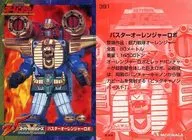
The Ohmobiles take ancient designs as their very subject: Sky Phoenix, Gran Taurus, Dash Leon (lion/sphinx), Dogrander (shakōki clay figure), and Moa Loader (moai), combining into Ohranger Robo — archaeology rendered as toy and robot.
Confirmed Analysis
A “machine vs. living power” axis
Our reading: by making the enemy a lifeless machine empire and the heroes’ power a “living” ancient force, the show centers a machine-versus-life axis. Even after the tone softened, that contrast remained its spine.
Likely Reception
Carried into the overseas Zeo
Its action footage was reused for 1996’s Power Rangers Zeo, recomposing the battles and giant-robot scenes for U.S. audiences — a foundation for that overseas line.
Confirmed Analysis
A machine-empire coincidence across two countries
Our reading: both Baranoia and Zeo’s Machine Empire set a “machine empire” as the foe. With the U.S. version building its own while drawing on the original’s machine-battle footage, the two lands ended up echoing the same motif — a coincidental seam.
Likely Production
Bearing the 20th-anniversary banner
It was planned as Toei’s “20th-anniversary” work in its count of the lineage. The grand premise of a U.N.-affiliated organization aimed at a scale befitting that milestone.
Confirmed Reception
Remembered as “the most unfortunate” Sentai
Because a milestone work was forced to change tone by its heavy year, some articles call it “the most unfortunate” Sentai. The framing reflects the writer’s angle, but it captures how singular the broadcast year was.
Likely Setting
Friday evenings, 48 episodes
It aired from March 1995 to February 1996 on TV Asahi, Fridays at 5:30 p.m., for 48 episodes. The finale is titled “Warriors of Love.”
Confirmed Cast
The commander is Hiroshi Miyauchi
U.A.O.H. Commander Miura is played by Hiroshi Miyauchi — a veteran tokusatsu hero who had been Shiro Kazami (Kamen Rider V3), Aoranger (Goranger) and Big One (J.A.K.Q. Dengekitai). The 20th-anniversary work placed an actor symbolic of the genre’s history at its command.
Confirmed Cast
Lead actors went on to period drama and variety TV
Masashi Goda (OhBlue / Yuji Mita) went on to play the fifth Kaku-san in the long-running period drama Mito Kōmon from 2003 to 2010. Tamao (OhPink / Momo Maruo, credited then as “Tamao”, later Tamao Sato) became widely known as a variety-TV personality. Note, though, that this was not her debut — she had been active since 1988, a point often mistaken.
Confirmed Cast
OhRed’s suit actor was Kazutoshi Yokoyama
OhRed’s suit actor was Kazutoshi Yokoyama — not Kazuo Niibori, the long-serving red suit actor he is sometimes confused with. Yokoyama went on to carry action work through the Heisei Kamen Rider era and beyond.
Confirmed Production
The head writer was Noboru Sugimura
The head writer was Noboru Sugimura, active across the franchise, with Toshiki Inoue, Hirohisa Soda, Shozo Uehara and Susumu Takaku also writing. SFX direction went to Hiroshi Butsuda, fresh from his main-unit debut on Kakuranger. Producers were Susumu Yoshikawa, Takeyuki Suzuki and Shigenori Takatera.
Confirmed Production
The voice cast gathered in Baranoia
The Machine Empire Baranoia boasted a rich voice cast: Emperor Bacchushund was voiced by Toru Ohira (Hakushon Daimaō; Moguro Fukuzo in Warau Salesman), Prince Buldont by Tomokazu Seki, and the retainer Acha by Kaneta Kikkawa. Both Seki and Kikkawa have voiced Suneo in Doraemon — so the old and new Suneo ended up together on the villains’ side.
Confirmed Reception
The VS series began with Ohranger
In March 1996, Choriki Sentai Ohranger vs. Kakuranger — pairing this show with its predecessor — was produced and released. Proposed by producer Susumu Yoshikawa, it is the first entry in the Super Sentai “VS series” of direct-to-video crossovers that became a near-annual tradition: the starting point for stories where new and old teams share the screen.
Confirmed Editorial notes
A squadron at the 20-year mark
The 19th Super Sentai, planned as a “20th-anniversary” work in Toei’s own count of the lineage. It launched in that milestone year with an ambitious premise: a U.N.-affiliated super-power squadron.
Chōriki: not superpowers but the peak of science
Their power comes from THenergy left by a super-ancient civilization, boosting the body 30–40 times. Producer Takeyuki Suzuki framed it not as pseudo-scientific superpowers but as the pinnacle of science.
The original tone: a hard defense-war chronicle
Every member was a professional soldier; New York and Paris fall as the threat closes on Tokyo. The series opened on a deliberately hard, serious line, distinct from earlier Sentai.
The shadow of the quake and the sarin attack
The Hanshin quake struck in January just before broadcast; the sarin attack came in March, around episode 3. In his own book, Suzuki wrote of doubting whether to make hard, serious children’s programming as the public mood darkened, noting that a real evil now surpassed fiction’s villains. The hard line was abandoned and comical elements added. The exact pivot episode varies by source, so we do not assert one.
The enemy: Machine Empire Baranoia
The foe is the Machine Empire Baranoia. A lifeless legion of machines, set in deliberate contrast to chōriki — the living power of an ancient civilization.
The mecha: ancient relics brought to motion
The Ohmobiles draw on real ancient designs: Sky Phoenix, Gran Taurus (bull), Dash Leon (lion/sphinx), Dogrander (shakōki clay figure), and Moa Loader (moai), combining into Ohranger Robo — a lineup that makes a child’s love of ruins literal.
A sixth, waking from 600 million years
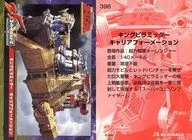
King Ranger (Riki), appearing around episodes 26–27, is a warrior of the ancient Pangaea civilization who pilots the colossal King Pyramider. An unusual sixth ranger who appears as a boy, deepening the story’s spine.
A theme carried by Kentaro Hayami’s bright voice
The opening “Ole! Ohranger” is sung by Kentaro Hayami, composed by Yasuo Kosugi, arranged by Ryo Yonemitsu, with score by Seiji Yokoyama. Against the hard premise, the theme is bright and approachable.
Across the sea, into another Machine Empire
The action footage carried into the 1996 U.S. Power Rangers Zeo. Notably, Zeo’s villains were also a “Machine Empire.” Ohranger’s enemy was already a machine empire, and the U.S. version independently set its own machine empire while reusing Baranoia’s battle footage — a telling seam.
Called “the most unfortunate squadron”
A 20th-anniversary work forced to change tone by the weight of its year, it has been called “the most unfortunate” Sentai. A year where celebration and real-world shadow coexisted.
The commander is played by tokusatsu legend Hiroshi Miyauchi
U.A.O.H. Commander Miura is played by Hiroshi Miyauchi — the actor behind Shiro Kazami in Kamen Rider V3, Aoranger in Himitsu Sentai Goranger, and Big One in J.A.K.Q. Dengekitai, a man who embodies the history of tokusatsu heroes. Casting him as the commander of the 20th-anniversary work put the genre’s own legacy at the heart of the show.
Head writer Noboru Sugimura; SFX director Hiroshi Butsuda
Noboru Sugimura, a writer who worked across the franchise, served as head writer, with Toshiki Inoue, Hirohisa Soda, Shozo Uehara and Susumu Takaku among the scriptwriters. SFX direction went to Hiroshi Butsuda, who had debuted on the main unit in the preceding Ninja Sentai Kakuranger. Producers included Susumu Yoshikawa, Takeyuki Suzuki and Shigenori Takatera.
Zeo’s gold warrior is Trey — a different character
King Ranger (Riki)’s footage became the Gold Ranger in Power Rangers Zeo, but his identity — Trey of Triforia — is an entirely original character, unlike the source. The giant fortress King Pyramider reappeared as Pyramidas. Here is a seam unique to an adapted show: the same footage carrying a different persona.
Still alive through guest appearances
In 2011, OhRed and OhPink guest-starred in episodes 31–32 of Kaizoku Sentai Gokaiger, putting the original costumes back on screen. In 2025 the series reached its 30th anniversary. A squadron born at the 20-year mark has kept being called back.
FAQ
Did Power Rangers use footage from Chouriki Sentai Ohranger?
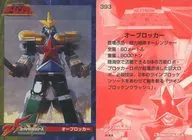
Yes. The US series Power Rangers Zeo (1996) was built by reusing this show’s suited-action and giant-robot footage, with only the drama scenes shot anew in America. Reused mainly: Ohranger henshin/zord battle footage — the core action of the season, All villain-HQ footage came from Ohranger (Baranoia = the Machine Empire), Ohranger Robo / OhBlocker reused as the Zeo Megazord / Super Zeo Megazord, King Ranger (the sixth warrior) footage reused for the Gold Ranger.
How many episodes is Chouriki Sentai Ohranger, and when did it air?
48 episodes. It aired from March 3, 1995 to February 23, 1996.
Who is the “sixth warrior” of Chouriki Sentai Ohranger?
KingRanger. The sixth, King Ranger / Riki, is a boy — the last survivor of the super-ancient dynasty — who joins from the second cours.
Can I still buy vintage Chouriki Sentai Ohranger toys?
Yes. Figures and DX toys still circulate on Japan’s second-hand market (Suruga-ya, Mercari, Yahoo! Auctions). Real listings are linked throughout this page; overseas buyers can follow our buying guide.


![【中古】スーパー戦隊シリーズ 超力戦隊 オーレンジャー [レンタル落ち] 全8巻セット [マーケットプレイスDVDセット商品]](https://thumbnail.image.rakuten.co.jp/@0_mall/2doriem/cabinet/y20260325-18/yhb01lwqvbnc.jpg?_ex=400x400)

![超力戦隊オーレンジャー オーレ VS カクレンジャー [DVD]](https://thumbnail.image.rakuten.co.jp/@0_mall/guruguru2/cabinet/945/dstd-2010.jpg?_ex=400x400)


![【送料無料】超力戦隊オーレンジャー VOL.1/特撮(映像)[DVD]【返品種別A】](https://thumbnail.image.rakuten.co.jp/@0_mall/joshin-cddvd/cabinet/288/dstd-06407.jpg?_ex=400x400)
![【送料無料】超力戦隊オーレンジャー VOL.3/特撮(映像)[DVD]【返品種別A】](https://thumbnail.image.rakuten.co.jp/@0_mall/joshin-cddvd/cabinet/874/dstd-06409.jpg?_ex=400x400)


![NO.19[N]:超力戦隊オーレンジャー](https://cdn.suruga-ya.jp/pics_webp/boxart_m/gu420712m.jpg.webp)
![R-019:超力戦隊オーレンジャー/[「暴太郎戦隊ドンブラザーズ」 DXドンブラスター早期購入特典]](https://cdn.suruga-ya.jp/pics_webp/boxart_m/gn303620m.jpg.webp)
![RS-142[SR]:オーレンジャーロボ](https://cdn.suruga-ya.jp/pics_webp/boxart_m/g8931999m.jpg.webp)

![XG-012[N]:レッドパンチャー](https://cdn.suruga-ya.jp/pics_webp/boxart_m/gl145121m.jpg.webp)


![スーパー戦隊 (学研の図鑑) [ 東映株式会社 ]](https://thumbnail.image.rakuten.co.jp/@0_mall/book/cabinet/7882/9784054067882.jpg?_ex=600x600)
